Private Tour
17 Days Azerbaijan Adventure Tour


Overview
Available languages
408 hours
Mobile ticket
Experience the pinnacle of cultural discovery and natural beauty with this 17-day elite journey across Azerbaijan. From Baku’s iconic Flame Towers, ancient Old City, and oil heritage to the fire temples of Absheron and the rock art of Gobustan, each day delivers unmatched depth. Travel through Shamakhi, Lahic, Gabala, and Sheki exploring royal palaces, mountain villages, and artisan traditions. Discover hidden gems in Qakh, Ganja, Quba, Khinalug, and the surreal Candy Cane Mountains. Conclude in Lankaran and Lerik with tea plantations, thermal springs, and timeless longevity culture. An extraordinary, experience crafted for those who demand the rare and unforgettable.
Additional Info
Public transportation options are available nearby
Infants are required to sit on an adult’s lap
Specialized infant seats are available
Suitable for all physical fitness levels
Guests must to be ready in hotel lobby or arranged meeting point 15 minutes prior to the scheduled pick up time.
Travelers are advised to review the Inclusions section in detail, as three pricing tiers are available based on the scope of services provided. The first option includes a guide and driver, with entry tickets excluded. The second option (Included Entry Tickets) comprises a guide, driver and entry tickets included. The third option, labeled "All Inclusive," encompasses all services and additional amenities offered within the tour package.
One-day trip to Khinalug: Dinner and breakfast will be provided at a village house, included in the all-inclusive package.
As specified in the Inclusions section, Accommodation is provided at 4* Hotel on DBL room basis if "All Inclusive" package option is selected. Accommodation includes: 7 nights in Baku; 1 night in Shamakhi; 1 night in Gabala; 4 nights in Sheki; 1 night in Quba, 1 night in Lankaran and 1 night in Khinalug Village house
As specified in the Inclusions section, all entrance tickets are provided if either the "Included Entry Tickets" or "All Inclusive" package option is selected. Entry admissions cover access to the following cultural, historical, and natural sites: Shirvanshah Palace, Maiden Tower, Carpet Museum, Heydar Aliyev Center, Gobustan Museum, Mud Volcanoes, Ateshgah-Fire Temple, Yanardag-Burning Mountain, Gala State Historical Ethnographic Reserve, Dir Baba Mausoleum, Alpaca Farm, Abgora Wine House with wine degustation, Zarnava suspension or Hanging Bridge, Lahic Village Museum, Cable Car Ride 2x lines in Tufandag, Nohurlake boat riding, Bio Garden Sheki, Sheki Museum of History, Sheki Art Gallery, Fazil Necropoli, Sheki Khan Palace, Kish Albanian Church, Shekihanovs’ House, Az Abrau Museum, Sumug-gala Castle, First Museum of Mountain Jews, Bottle House, Lankaran Khan's House, Longevity Museum-Lerik and Chanlibel Lake.
Cancellation Policy
For a full refund, cancel at least 24 hours before the scheduled departure time.
What‘s Included
1 dinner with local Village cusine local in Khinalug Villlage (if All Inclusive option selected)
Daily buffet breakfast at the hotels (if All Inclusive option selected)
Accommodation - 15 nights at 4star Hotel on DBL room basis (if All Inclusive option selected)
All Entrance Fees (if the "Included Entry Tickets" or "All Inclusive" option selected)
English speaking tour guide
15 dinners with mix of buffet and local restaurants (if All Inclusive option selected)
Accommodation - 1 night in Khinalug Villlage house (if All Inclusive option selected)
Round-trip airport transportation, hotel pick-up and drop-off, and transport throughout the tour
Anything not mentioned in the inclusions
Meeting and Pickup
Pickup points
Heydar Aliyev Intl Airport
Baku Azerbaijan
What To Expect
Arrival and Iconic Baku Skyline Experience – Panoramic Evening Tour
Arrival at Heydar Aliyev International Airport initiates a direct transition into the architectural and cultural core of Baku. Guests are received with immediate airport pickup and conveyed via private transfer to the hotel, where the check-in process is completed without delay, allowing a seamless progression into the rest phase.
Highland Park
The itinerary then unfolds with a visit to Highland Park, Baku’s elevated urban vantage point. From this commanding position, guests engage directly with panoramic views of the city’s modern silhouettes and the Caspian horizon. Guests will visitThe Flame Towers, Martyrs' Lane, the Eternal Flame Monument and coastal key highlights. Return to the hotel finalizes the day, allowing time for personal recalibration. The first day concludes with an uncompromising visual and spatial introduction to Baku designed to elevate perception. The total duration of the tour will span approximately 4 hours, encompassing guided on-site explanations by a professional expert, travel intervals between key landmarks, and the initial airport-to-hotel transfer.
Baku City Tour - Structural Memory and Modern Continuum - From Fortress to Futurism
Baku Old City
The day initiates with a purpose-oriented breakfast at the hotel, designed to support endurance and cognitive readiness across a high-engagement, multi-sector itinerary. The morning opens within Icherisheher (Old City) - not as a preserved district, but as a living infrastructure of accumulated functions. The walk-through is neither nostalgic nor anecdotal; each stop reveals layers of power, function, and continuity. The House of Baku Khans, Multani Caravanserai, The Maiden Tower, St. Bartholomew Church, Juma Mosque, Muhammad Mosque, Aga Mikayil Bath House, Miniature Books Museum and Palace of the Shirvanshahs and domes, tombs, and stone inscriptions operate not as decoration but as coded expressions of sovereignty, belief and legacy.
Heydar Aliyev Cultural Center
The tour transitions toward high-concept design language with the next destination: the Heydar Aliyev Cultural Center. The structure characterized by continuous surfaces and non-Euclidean geometry functions as both a physical break from orthogonal architecture and a symbolic shift into non-linear thinking. Exhibition content is spatially integrated, making the building itself an interface for national narrative, industrial design evolution, and material innovation.
Azerbaijan National Carpet Museum
The afternoon phase shifts to Baku’s engineered waterfront. The route spans Baku Boulevard, a linear coastal construct designed to balance public access with high-function infrastructure. The Carpet Museum, shaped as a roll in permanent suspension, houses textile archives that merge craft with archaeology each exhibit framed by lighting and temperature controls to stabilize fiber integrity over time. Little Venice, a micro-canal system, operates as controlled waterway infrastructure within a larger pedestrianized zone, offering movement without disconnection.
Nizami Street
Final stops include Nizami Street and Fountain Square - the economic and social core of modern Baku. Nizami’s commercial facades display a synthesis of classical ornamentation and retail function, while Fountain Square operates as an urban lung, with kinetic water features and embedded lighting systems forming a nighttime grid of pedestrian orientation and visual rhythm. Return to the hotel completes the cycle. Total duration spans approximately 6 to 8 hours, factoring in professional-level site interpretation, transportation time between sectors, and calibrated pauses for photographic documentation.
Gobustan and Mud Volcanoes Tour - Explore Ancient Rock Art and Mud Volcano Wonders
The day initiates with a breakfast optimized for endurance designed to prepare for an encounter with one of the most data-rich open-air archives of early human expression and geodynamic activity in the South Caucasus. The journey begins with departure from the hotel, directing movement toward Gobustan National Reserve, a site recognized by UNESCO not for its aesthetic appeal, but for its quantifiable contribution to the global record of prehistoric cognitive systems. The first stop engages the Gobustan Museum, where high-resolution mapping, interactive projection systems, and layered artifact displays converge to provide calibrated context. Here, digital augmentation merges with physical relics to establish interpretive clarity across Paleolithic to Iron Age transitions.
Gobustan Rock Art
Exiting the museum, the next phase shifts to direct terrain analysis. The Gobustan Petroglyphs reveal over 6,000 individual carvings. Each petroglyph operates as a visual code: hunting scenes, ritual sequences, anthropomorphic forms, and astronomical alignments. These are not artistic gestures; they are early data systems, executed with precision tools and reflecting a structured worldview. The surrounding topography, defined by fractured limestone and natural wind corridors, functions as both a natural amplifier and acoustic chamber conditions ideal for ceremonial use.
Mud Volcanoes
From cultural strata to geodynamic phenomena, the route transitions toward the Mud Volcano fields, located on the semi-arid plains beyond Gobustan. These geological structures, numbering over 300 across Azerbaijan, account for the highest concentration globally. Onsite activity includes observation of active vents, where methane-driven expulsions create surface-level domes of cold mud, high in trace minerals and naturally antibacterial compounds. Following the return to Baku, the afternoon phase offers open-choice activity within the city center - a controlled interval for personal calibration, architectural study, or urban exploration. This segment is designed for optional engagement based on individual interest, within proximity to Baku’s cultural and commercial core. The day concludes with return to the hotel. Total duration spans approximately 5 to 6 hours, factoring in expert-led explanation, travel time and analytical observation at each site.
Fire Worshippers’ Legacy Tour - Journey to the Legendary Fire Temples and Eternal Flames Yanardag
Ateshgah - Fire Temple
This day’s itinerary is designed to immerse travelers in the elemental core of Azerbaijan’s natural and cultural identity, centering around the rare convergence of geological phenomena and ancient religious heritage. The journey begins after an early morning breakfast at the hotel, followed by a timely departure from central Baku. The route strategically navigates toward the Absheron Peninsula, where fire is not metaphor but matter. The first major stop is the Ateshgah-Fire Temple, an architectural testament to a forgotten era of Zoroastrian reverence. The naturally burning gas vents once sustained an eternal flame, believed to channel the divine essence of the universe. Visitors are given structured access to each chamber of the temple, guided by expert interpretation that contextualizes the temple’s evolution from a Silk Road sanctum to a site of theological contention and preservation.
Yanar Dag
Following Ateshgah, the journey continues northward to Yanardag, a rare geological formation where subterranean natural gas continuously feeds flames leaping along a 10-meter-long embankment. This phenomenon, more than spectacle, is an enduring scientific anomaly a perpetual blaze defying seasonal change and meteorological variance. Its unmanipulated combustion has shaped not only local folklore but also academic inquiry into Azerbaijan’s vast hydrocarbon reservoirs. Travelers are positioned for strategic observation, optimal photographic angles, and guided insights into the tectonic and chemical mechanisms fueling this mountain of fire.
Fountain Square
After immersing in the raw presence of natural flame, the itinerary transitions into a contrasting rhythm with a stop at Nizami Street also known as Fountain Square. The pacing of this final visit allows for unhurried exploration and elite-level engagement with Baku’s sociocultural pulse. The return to the hotel is prompt and efficiently managed, ensuring a seamless transition into the evening. The day’s arc from ancient rituals to geophysical marvels and cosmopolitan elegance delivers a concentrated narrative of elemental power and human interpretation, engineered to leave a lasting cognitive and emotional imprint. The total excursion spans 6 to 8 hours, accounting for logistical transitions, in-depth site briefings, and photographic intervals, all synchronized under the guidance of a domain-specialist interpreter.
Absheron Tour - Journey to Fortress Strongholds and Oil Industry Origins
Mardakan Castle
This itinerary is a focused investigation into the geopolitical architecture of pre-modern defense systems and the transformative inception of global energy infrastructure. Following breakfast at the hotel, the journey initiates with a direct transfer from Baku into the fortified belt of the Absheron Peninsula an area that served as both a defensive barrier and a staging ground for the world’s earliest oil-driven modernization. The day opens at Mardakan Castle, one of the most structurally advanced defense complexes in the Caucasus. The castle’s spatial dimensions and vantage planning were oriented toward full perimeter dominance and layered counterattack capabilities, reflecting the operational sophistication of 13th-century fortification theory. Both castles present a comparative analytical case for how resource availability, topography, and external threats informed fortress typology within the same regional power base.
The exploration proceeds to the Gala State Historical Ethnographic Reserve, a deeply layered cultural repository offering a live archetype of rural Azerbaijani life across several historical periods. Rather than presenting reconstructions or dramatizations, the Reserve features original dwellings, underground storage systems, defensive walls, and industrial tools positioned according to archaeological evidence. This complex enables a spatial reading of community infrastructure under environmental and economic constraints essential for understanding the social architecture that existed parallel to the military and industrial evolution of the peninsula.
Following this, the route moves toward Balakhani Village, one of the earliest documented settlements to engage in industrial-scale oil extraction. Before the arrival of foreign technology, Balakhani operated hand-dug wells and primitive distillation systems, which laid the operational framework for subsequent mechanized exploitation. The village environment reveals the earliest interaction between labor, land, and liquid fossil fuel. This forms a contextual bridge toward the next destination: the world’s first mechanically drilled oil well, commissioned in 1846 decades before Pennsylvania. Located on the Absheron Peninsula, this site represents not a historical curiosity but the inaugural moment of the global energy economy. Its documentation, engineering, and output volumes are critical inflection points in both petroleum history and the geopolitical mapping of hydrocarbon resources.
Bibi-Heybat Mosque
Before concluding the day, a stop is made at the Bibiheybat Mosque - a critical nexus of spiritual and industrial timelines. The mosque, originally constructed in the 13th century and later reconstructed after Soviet demolition, is positioned adjacent to oil fields that revolutionized Baku. This physical juxtaposition between religious reverence and industrial ascendancy forms a dual narrative of heritage preservation and modernity-driven disruption. The return to Baku concludes an itinerary driven by analytical precision and thematic continuity. Over 6 to 8 hours, the journey provides a clear intellectual and visual narrative of how territory, defense, faith, and fossil energy converged to shape one of the most strategically significant regions in the modern world.
Shamakhi Tour - Architectural Masterpieces and Natural Beauty
This itinerary delivers an integrated examination of Shamakhi as a locus of architectural permanence and environmental calibration. Following hotel check-out and departure from Baku, the route proceeds westward into a geographic corridor where seismic zones, empire histories, and agrarian thresholds converge. The day is structured around six distinct yet interconnected destinations that function as critical nodes in the narrative of Azerbaijan’s spiritual, civic, and ecological identity. The first focus point is the Diribaba Mausoleum, a dual-level structure carved into vertical limestone rock, positioned at the intersection of topographic instability and religious ascension. Dating back to the 15th century, this edifice is a study in structural defiance merging natural cliff-face integration with Islamic funerary geometry.
Juma Mosque
The progression continues to Juma Mosque of Shamakhi, the oldest and largest mosque in the Caucasus region, originating in the 8th century under Abbasid influence. The current structure is an outcome of multiple reconstructions following seismic disruptions each rebuild reflecting shifts in regional aesthetic and political tone.
Yeddi Gumbaz Mausoleum
Subsequent entry to Yeddi Gumbaz Mausoleum Complex presents an elevated necropolis of the Shirvan royal family. The seven-domed arrangement, though only three have survived, is geometrically rationalized and spatially elevated to dominate the valley below.
Alpaca Azerbaijan
Transitioning from legacy stone to living landscape, the itinerary then shifts to an Alpaca Farm, which introduces modern pastoral infrastructure into the region’s traditional agronomy.
The Abgora Wine House visit integrates oenological science with endemic varietal preservation. The facility is not only a production unit but a regional nucleus for fermentation innovation using indigenous grapes. The visit includes a guided walkthrough of the fermentation cellars, barrel storage systems, and cold-stabilization technologies.
The final stop at Silent Lake is a natural terminus for the day’s movement. Positioned at mid-altitude and ringed by forested slopes, the lake offers a chromatic and auditory shift serving as a low-intervention ecological space maintained for atmospheric balance and hydrographic control. The itinerary closes with arrival and overnight stay in Shamakhi, completing a day where each location builds on a sequence of permanence, resilience, and adaptation crafted to reveal not just what stands in Shamakhi, but why it has endured. Total duration spans 7 to 8 hours, accommodating guided technical briefings, transitional intervals, and calibrated rest phases.
Shamakhi and Lahic Tour - Scientific Discovery and Authentic Mountain Village Life
Shamakhy Astrophysical Observatory
The day begins with hotel check-out, followed by a direct transfer to the Shamakhi Astrophysical Observatory, the national epicenter for astrophysical research, located at 1,500 meters above sea level in the Pirkuli region. Established in 1959, this facility integrates international-standard telescopic arrays with optimal atmospheric transparency - a rare convergence that qualifies it as one of the most technically valuable observatories in the Eastern Hemisphere. The site offers access to high-magnification reflecting telescopes capable of tracking solar activity, planetary movement, and deep-sky phenomena with sub-arcsecond precision. Visitors receive a technically guided walkthrough covering instrument calibration, data collection methodology, and Azerbaijan’s contribution to global astrophysical modeling.
Lahic
From pure science, the itinerary transitions to ethnographic density with an excursion to Lahic Village, a settlement embedded into the southern slopes of the Greater Caucasus at approximately 1,200 meters altitude. Lahic is globally recognized for its copperware industry, executed through centuries-old guild systems. Each workshop is an active site of material transformation where metal composition, thermal treatment, and decorative incision follow codified techniques resistant to industrial dilution.
The journey intensifies with a stop at the Zarnava Suspension Bridge, located at the edge of Lahic’s highland perimeter. Engineered as a narrow-crossing cable bridge suspended over a steep forested ravine, it embodies both minimalism and functionality. Crossing the bridge provides a kinetic understanding of topographic disjunction, spatial exposure, and highland risk navigation. The final transfer to Gabala for hotel drop-off and overnight stay concludes the itinerary. Duration spans 6 to 8 hours, inclusive of in-depth site interpretation, measured travel segments, and targeted observation points. The entire day functions as a calibrated movement across vertical hierarchies of knowledge: scientific, artisanal, and structural engineered to deliver a rigorous, unembellished immersion into environments shaped by observation, necessity, and elevation.
Gabala’s Peaks and Sheki’s Historic Trade Routes
Following breakfast and departure from Gabala, the first ascent is toward Tufandag Mountain Resort - an alpine infrastructure project at the intersection of natural elevation and mechanical precision. The cable car network provides not scenic amusement but strategic vertical access, cutting across climatic layers and terrain configurations that traditionally constrained settlement and mobility. The elevation gain is used to understand watershed behavior, vertical vegetation zoning, and the ecological mechanics of the Greater Caucasus range.
Descending from altitude, the itinerary proceeds to Nohur Lake, a hydrological basin located at 700 meters above sea level. This lake functions as a natural mirror of the region’s climatic inputs. Its stillness serving as a data field for wind directionality, rainfall distribution, and solar reflection.
Yeddi Gozel Waterfall
Further movement leads to Yeddi Gozel (Seven Beauties Waterfall), positioned within a dense forest escarpment. This vertically tiered waterfall system demonstrates sequential kinetic energy release, producing localized humidity that supports micro-ecological diversity. Visitors experience the hydrodynamic rhythm of the falls as a geophysical event shaped by erosion gradients and limestone fracture lines.
Chotari Albanian-Udi Church
The next vector of interest is Nidj Udin Village, home to the Chotari Albanian Church, an architectural remnant of the Caucasian Albanian ecclesiastical tradition. Its presence within a contemporary Udi ethnic enclave bridges religious continuity with ethnolinguistic preservation.
Bio Garden
The route then advances to Bio Garden Sheki, a controlled agricultural zone operating under principles of organic integrity and species diversification. Here, seasonal crop rotation, vertical planting systems, and soil recovery protocols are practiced at functional scale. The garden serves not as display but as proof of applied biospheric intelligence, integrating native fruit genetics and controlled irrigation into a profitable, sustainable model.
Sheki Karvansaray
The next anchor is the Sheki Caravanserai, a 17th-century logistical hub that once formed part of the northern branch of the Silk Road. With precise courtyard orientation, cold storage systems, equestrian access lanes, and embedded commercial cells, the caravanserai demonstrates passive architectural intelligence optimized for merchant flow and long-duration habitation.
The final site visits focus on Sheki’s halva workshops and artisanal retail blocks, functioning as micro-economies rooted in technique rather than scale. Halva production here is conducted in manual phases using proprietary reductions of sugar, rice flour and locally sourced nuts. Arrival and hotel check-in in Sheki marks the end of the day’s sequence. Total duration spans 8 to 10 hours, incorporating topographic movement, detailed explanation at each site and structured exposure to both engineered systems and cultural continuities.
Sheki Tour - Cultural Heritage - Palaces, Artisans and History
Abad Ceramics And Applied Art Center
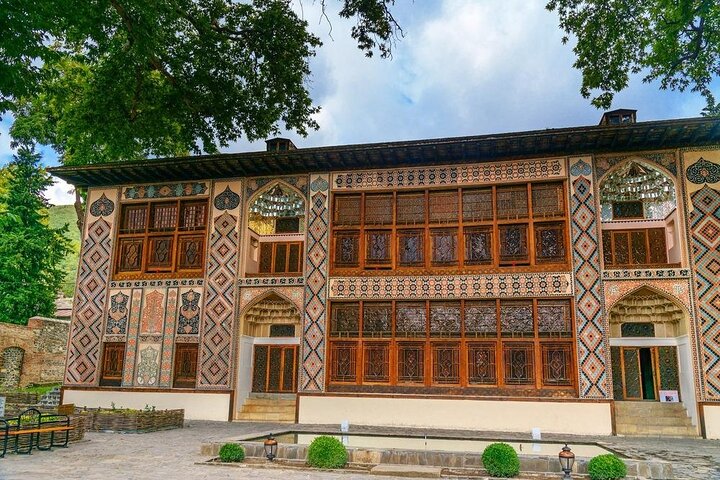
After hearty breakfast at the hotel, the itinerary begins with a visit to the Sheki Khan’s Palace, one of the most outstanding architectural landmarks in the South Caucasus. The palace is distinguished by its detailed stained-glass windows (shebeke), vibrant frescoes, and finely painted wooden surfaces. No synthetic materials, no modern reinforcements only hand-cut wood and colored glass fitted with absolute technical discipline. It is an architectural work that operates both as historical record and aesthetic marvel. Guided interpretation focuses on the harmony between natural light and ornamental geometry, offering travelers not just visual appreciation, but spatial awareness of 18th-century design philosophy. Next is the ABAD Ceramic Arts Centre, a functioning artisan hub focused on ceramic production. Visitors gain access to behind-the-scenes views of pottery shaping, glazing, and kiln firing each step reflecting high-level manual skill applied with contemporary presentation.
The tour continues with a visit to the Sheki Museum of History and Local Lore, where the region’s broader historical narrative is displayed through tangible exhibits architectural fragments, tools, textiles, and local costumes. The museum organizes its collection around the evolution of Sheki as a key node in trade, craftsmanship, and civic development.
Following this, the Art Gallery provides a selective yet high-value stop. Focused on paintings, graphic works, and local visual art traditions, the gallery represents contemporary interpretations of Sheki’s cultural themes. This setting allows for deeper visual engagement in a calm, uncluttered environment, elevating the overall experience with authenticity and artistic clarity.
At the Craftsmen’s House, the journey returns to process-focused tradition. Here, shebeke artisans work in real time, assembling colored glass and hand-carved wooden elements into geometrically perfect window designs. Visitors observe not a performance, but a fully active production space.
Fazil Labyrinth-museum
Finally, the visit concludes at Fazil Necropolis, a peaceful and visually striking hilltop site that reflects the region’s layered history through traditional grave structures and landscape integration. The elevated viewpoint offers quiet panoramic perspectives over Sheki and its natural surroundings, making it a fitting conclusion to a day rooted in depth, detail, and refined cultural experience. The full itinerary spans approximately 4 to 5 hours, carefully paced to allow for meaningful engagement at each location.
Sheki Tour - The Silk Road’s Legacy: Sacred Sites and Traditional Crafts
Church of Kish
The day begins with breakfast at the hotel. First visit is to the Kish Albanian Church, a structure of precise symmetry and stonework, positioned in the village of Kish. This church small in scale yet powerful in presence serves as a rare architectural survivor from early Christian civilization in the Caucasus. Visitors experience a compact yet deeply rooted site where interior light, proportion, and stone composition converge to express historical gravity. Interpretive guidance explains the church’s layout, its construction methodology and its continuing relevance as a cultural marker.
Sheki
From spiritual legacy to noble life, the next stop is the Shekikhanovs’ House, a residential estate of Sheki nobility reflecting late 18th-19th century domestic refinement. The architecture features intricately painted ceilings, decorative panels and spatial hierarchy designed for privacy, hospitality, and cultural symbolism. Every room is calculated in layout and ornament, offering an in-depth understanding of how material status was expressed through artistic control and household symmetry.
The itinerary then advances to the Sheki Silk Factory, a working link to the city's historical role as a major silk producer along the transcontinental trade routes. Visitors observe the entire production chain from cocoon processing and dye preparation to weaving on wooden looms. Insight is given into traditional silk patterns, texture calibration, and dye techniques rooted in natural resources.
Sheki Khan's Mosque Complex
The tour proceeds with a stop at the Khan Mosque, located in the historical district. Modest yet architecturally sound, the mosque reflects clean lines, proportional balance and material economy.
Next is the Abdulkhaliq Hammam, one of the few remaining traditional bathhouses in Sheki. This site offers a look into the architecture of ritual cleanliness, social interaction and spatial temperature control.
Sheki Wines
The Az Abrau Wine Museum is the next stop, introducing an elegant contrast through regional enology. Housed in a carefully restored building, this boutique-level museum presents the development of Azerbaijani wine culture through locally cultivated grapes. Visitors explore fermentation rooms, barrel displays, and historical bottling systems while tastings allow firsthand experience of dry whites and light reds unique to the region’s landscape.
The itinerary closes with a visit to the Sheki Bazaar, an active commercial zone offering locally sourced produce, spices, dried fruits, cheeses, and handmade goods. The bazaar layout, vendor organization, and product range provide a live reading of daily trade behavior in Sheki. Visitors have the opportunity to engage, taste and purchase directly from local producers, gaining authentic insight into what sustains the city beyond its historic monuments. After completion of the tour, the group returns to the hotel for overnight in Sheki. The entire experience spans 4 to 5 hours, precisely aligned for concentrated, content-rich exposure. Every stop is structurally and culturally integrated into Sheki’s historic function as a religious center, an aristocratic seat, a manufacturing node, and a trade corridor.
Qakh Tour - Fortress Castles, Ancient Temples and Ethnographic Treasures
Kurmuk Temple
The itinerary opens with breakfast at the hotel, setting a composed start before entering a focused journey across northern Azerbaijan’s architectural resilience and ethnographic significance. This day is a deliberate progression through fortress remnants, spiritual structures, trade heritage, and preserved traditions each destination offering direct insight into the structural and cultural logic that shaped the region. The route begins at the Kurmuk Temple, a religious landmark positioned near the forested highlands. This compact stone sanctuary, surrounded by natural elevation and silence, represents centuries of continuous spiritual relevance.
Next is the Qum Basilica, a rare early-period structure notable for its foundational simplicity and volumetric presence. Unlike heavily restored monuments, this basilica maintains its raw architectural identity where the weight of stone and precision of proportion stand without ornament. This site speaks to endurance, clarity and spiritual scale without distraction.
The tour continues with Sumug-gala Castle, a defensive fortress strategically positioned to control movement and monitor approach. The structure’s partial ruins allow direct visual access to its original layout walls, towers and vantage lines. What remains is enough to read the intelligence behind its construction: built not just for defense, but for long-term command over surrounding terrain.
Transitioning into infrastructural design, the next stop is the Ulu Bridge, a historical crossing point that reveals how mobility and engineering once intersected. The bridge’s arched span, stone detailing, and placement over river channels demonstrate the logic of material efficiency combined with regional trade needs. It’s a functioning example of form supporting utility over centuries.
Ulu Mosque
The Ulu Mosque, situated within the same urban fabric, follows. It represents a traditional architectural rhythm: restrained in volume, clean in line, and symmetrical in plan. Interior focus is on spatial purity and controlled natural light. Visitors engage with the structure not as tourists but as observers of proportion, silence, and craftsmanship executed in discipline.
Icheri Bazar Square
A walk through the Icheri Bazaar - Old Quarter offers a contrasting dynamic. This is a layered urban space, where residential geometry meets historical trade life. Stone-built homes, narrow lanes, and corner workshops create a grid shaped by centuries of use. The architectural language here is adaptive responsive to slope, shade, and seasonal air flow.
From architectural substance to organic production, the itinerary next reaches the Honey House in Lekit Village. This location offers a high-value experience rooted in micro-production. Local honey, harvested from unaltered mountain flora, is presented alongside insight into beekeeping methods and hive management.
Qakh
The tour concludes at the History and Ethnography Museum, where the previous experiences are contextualized within broader cultural narratives. The museum’s collections include tools, garments, maps, household items, and written records collected to construct a profile of local identity, regional development, and heritage preservation. After the final visit, guests return to the hotel for overnight in Sheki. The total duration of the day’s program spans 5 to 6 hours, designed for immersive, detailed engagement.
Ganja Tour - Mausoleums, Masterpieces and Monumental Stories
Nizami Ganjavi Mausoleum
The day begins with breakfast at the hotel, setting a composed and focused tone before departing for one of Azerbaijan’s most historically layered and structurally significant cities - Ganja. This is a full-day expedition across monumental architecture, intellectual legacy and preserved public spaces. Following hotel check-out, the route begins with a visit to the Mausoleum of Nizami Ganjavi, the towering tribute to one of the most influential literary figures in the world. The structure’s minimalist geometry and vertical scale are designed to express timeless relevance. Surrounded by landscaped grounds and symbolic motifs, the mausoleum stands as a deliberate alignment of intellectual weight and architectural restraint.
Imamzadeh Mausoleum
The next stop is the Imamzadeh Mausoleum, a distinctive example of Islamic funerary architecture in western Azerbaijan. The complex reveals a synthesis of religious function and architectural grandeur such as turquoise domes, intricate tiling and rhythmic arcades set within a walled sanctuary.
Shah Abbas Mosque
The tour proceeds to the Shah Abbas Mosque, built under the order of the Safavid ruler in the 17th century. It is a precision-based structure: red brick, fluted domes, and symmetrical prayer halls form a unified visual statement of imperial craftsmanship. Inside, the use of acoustics and light demonstrates refined environmental control a key trait of religious architecture designed for enduring functionality.
Shah Abbas Caravanserai
From there, the group visits the Ganja Caravanserai, a restored commercial compound once central to Silk Road trade operations. The building’s symmetrical courtyards, solid stone arcades, and vaulted halls reveal the logistical intelligence of early merchant architecture.
Mausoleum of Javad Khan
The Javad Khan Mausoleum follows, positioned within the grounds of Ganja Fortress remains. Compact in size but dense in symbolism, it honors the last khan of Ganja and serves as a physical narrative of sovereignty, loyalty and resistance.
Bottle House
The itinerary then shifts to the Bottle House, one of Ganja’s most distinctive private architectural statements. Constructed from over 40,000 glass bottles by a local resident as a personal tribute, the house represents material innovation within a private context.
Khan Bagy Park
The final stop in Ganja is Khan Baghi Park, a structured urban green space formerly reserved for nobility. It remains one of the oldest and most disciplined landscape designs in Azerbaijan, where pathways, water elements, and tree alignments were established to serve both retreat and representation. Following the last visit, the group returns to Baku with drop-off and overnight stay at the hotel. This full-day itinerary spans approximately 12 to 13 hours, integrating religious landmarks, historical infrastructure, artisan design, and spatial memory.
Quba Tour - Guba’s Unique Cultural Mosaic and Traditional Crafts
The 13th day of the journey is a deep dive into one of the most intellectually and culturally layered corners of Azerbaijan - Quba. Far from being a mere destination, this day is a passage through centuries of coexisting traditions, master craftsmanship, and untouched authenticity. After breakfast and check-out, the route begins with a seamless transfer from the hotel to the ethereal landscape of Red Village - the only all-Mountain-Jewish settlement in the world. Here, the Grand Synagogue rises in solemn elegance, a rare architectural and spiritual landmark untouched by time. Its serene presence speaks not just to religious devotion, but to centuries of cultural resilience.
From there, the journey continues to the Museum of Mountain Jews - a facility unlike any other in the Caucasus. This is not a museum of relics; it is an archive of living memory. Each exhibit is curated with forensic precision, revealing not just artifacts but the philosophical, linguistic, and artisanal traditions of one of the most underrepresented Jewish communities in the world.
Next, the path leads to the Gedim Quba Carpet Weaving Centre, an immersive showcase of Azerbaijan’s highest-caliber textile artistry. Here, master weavers follow centuries-old patterns from memory, using natural dyes derived from local plants and minerals. The knots per square centimeter are counted not for luxury labels, but to measure generational skill. With approximately 6 to 7 hours of expertly guided engagement, interspersed with strategic pauses for photographs and transitions between sites, this day achieves something rare. The day concludes with check-in and overnight stay in Quba, anchoring the experience not in conclusion but in contemplation.
: Quba’s Heritage and Untouched Traditions + Transfer to Guba
Following breakfast and departure from Quba, the journey begins with a deliberate detour to Chanlibel Lake. This is not merely a natural site, but a controlled environment of reflection. The lake’s elevation and glass-surfaced stillness offer more than scenic value; they operate as a sensory reset visual silence before cultural immersion. The balance of altitude, terrain, and atmosphere here produces a rare clarity, both physical and perceptual.
Next, the route continues to Juma Mosque, dating back centuries yet firmly embedded in modern communal rhythm, this structure offers a precise juxtaposition between historical theology and everyday continuity. The structure’s masonry, inscriptional detail, and spatial ratios serve as a tactile link to Islamic scholasticism and regional expression.
From there, the Guba Bazaar operates as a concentrated sampling of the region’s sensory economy. This is not a place for generic goods, but a decoding of Guba’s agricultural and artisanal intelligence. Herbs aligned in chromatic precision, hand-cut cheeses wrapped in local cloth, and produce reflecting altitude-specific cultivation methods.
The transition to the Honey House introduces a focused study on micro-ecology. This is not honey as souvenir, but honey as data - each jar representing controlled pollination processes, botanical mapping, and extraction techniques that are hyper-localized.
Khinalug
Then comes Khinalug Village, the core of this journey. Sitting at over 2,300 meters above sea level, this is one of the oldest continuously inhabited highland settlements in the world. Here, language, architecture, and lifeways are sealed off from homogenization. Houses are built one on top of another, forming a vertical chain of life that economizes both space and heat. With a total duration of 7 to 9 hours including technical guidance, photo documentation breaks and transit time across terrains that range from semi-alpine to full highland. The day closes with an overnight stay in Khinalug itself, not for experience, but for absorption.
Nature’s Spectacle: Birdwatching in Beshbarmaq and Candy Cane Mountains Tour
The itinerary commences with an early departure from Khinalug Village following breakfast. The descent from high-altitude terrain transitions quickly into lowland ecological zones. This change in altitude is not incidental; it aligns with one of the most significant bird migration funnels on the Eastern European-Caspian corridor. The first destination is the Besh Barmag (Five Fingers), a critical migration checkpoint recognized by ornithologists and ecological institutes across the region. Positioned between the Greater Caucasus and the Caspian Sea, this site sees seasonal passage of over a million birds representing more than 300 species including eagles, hawks, falcons, and large flocks of passerines. The concentration of movement, particularly during spring and autumn cycles, makes this one of the most data-rich observation points in the Caucasus.
Candy Cane Mountain
Following this, the tour continues to the Candy Cane Mountains - a site of exposed sedimentary layering, located in the semi-arid desert zone of the Khizi region. These mountains exhibit rare tri-chromatic striping, formed by oxidation of iron-rich minerals across millions of years. The visual gradient red, white, grey is not superficial coloring but a chemical record of climate, erosion, and seismic intervals. The lack of plant life across the formation enhances visibility and makes this terrain an optimal study of sedimentation processes without interruption by surface cover. After the completion of both core visits, the group proceeds via direct transfer to Baku. Driving time is managed to allow for technical stops, photography, and short explanatory sessions at key vantage points. The entire program spans 6 to 7 hours, adjusted for terrain conditions and light availability.
Lankaran Tour - Lankaran’s Subtropical Riches and Historical Landmarks
Tower of Zindan
This day offers a structured survey of Azerbaijan’s southernmost corridor, where subtropical climate, layered political history, and thermal-geological activity converge within a compact but highly diversified region. Lankaran’s location on the Caspian coastline and proximity to the Talysh Mountains create a microclimate and cultural formation unmatched in the country. Each stop on this itinerary is selected to isolate specific architectural, historical, and environmental variables delivering a dense and high-value observation sequence. The program begins after hotel check-out and immediate departure to the Circular Castle and Old Prison Complex (also referred to as the Round Tower or Zindan Tower). This fortified structure, constructed in the 18th century, functioned as a defensive watchtower and later as a high-security detention site. Its cylindrical architecture reflects adaptive military engineering, optimized for both surveillance and insulation.
The next focus is the Lankaran Khan’s House, now repurposed as the city’s primary history museum. This estate delivers a layered representation of ruling lineage, regional governance, and the socio-political tensions of the pre-Russian annexation era. Exhibition content includes land ownership documents, Talysh ceremonial artifacts and restored interiors that retain original spatial configurations.
The tour continues to Lankaran Railway Station Square, anchored by the Lankaran Lighthouse, a Soviet-era maritime structure that remains operational. The station square reflects strategic transport logistics from the late 19th to mid-20th century, and the lighthouse functions as a calibrated coastal instrument, guiding navigation across the southern Caspian approach.
Transitioning from structure to ecology, the next segment moves to Tea Plantations in the subtropical belt of Lankaran. Due to its unique latitude, humidity and rainfall levels, the region sustains year-round cultivation of Camellia sinensis with optimal yield.
An optional stop at the Ibadi Thermal Spring Bath House introduces hydrothermic mineral bathing, a long-standing local practice supported by naturally pressurized underground reservoirs. These waters are saturated with sulfur, calcium and magnesium elements proven to accelerate metabolic recovery and joint mobility. The experience is offered as a direct, time-controlled exposure, without cosmetic modification or commercial dilution.
Yanar Bulag (Fire Spring)
The tour then advances to Yanar Bulag - the Fire Spring in Astara and a phenomenon where methane-laced groundwater ignites upon contact with air. This site is a point of geological instability layered over a freshwater source, combining hydro and gas emissions in one vertical escape point.
Khanegah Tomb
The final structured visit is to the Hanega Complex, a former religious and intellectual hub that once served as a center of Sufi scholarship. The complex includes burial chambers, lecture spaces, and ceremonial halls. Spatial alignment, inscriptional design and architectural restraint distinguish it as a site of disciplined theological engagement. The entire day spans 8 to 10 hours, adjusted for distance intervals, technical explanation, and observational segments. The program concludes with overnight accommodation in Lankaran, positioning travelers at the terminus of the southern circuit not for pause, but for continuation into adjacent zones of the Caspian’s lower threshold.
Lerik’s Longevity Secrets and Pristine Natural Reserves
The final day is structured around maximum information yield within a fixed temporal boundary, integrating ethnographic insight and protected ecosystems. The morning begins with hotel check-out and departure for the Boyuk Bazar, Lankaran’s principal local market. Unlike tourist-oriented bazaars, this is a high-functioning economic interface that processes seasonal produce, regional herbs, and localized commodities. Product cycles here are driven entirely by climate, elevation, and trade habits, offering a last-scan summary of what the southern corridor yields in real-time.
Khanbulanchay Reservoir
The route continues to Lake Khanbulan, located within the bounds of Hirkan National Park and officially designated as the Khanbulanchay Reservoir. Surrounded by endemic Hirkan forest species, this artificial lake integrates water supply engineering with biodiversity protection. Observation includes brief environmental analysis, terrain behavior, and visual access to both riparian and forest ecosystems.
From ecology to biology, the day advances to Lerik’s Longevity Museum - a data-driven exploration into one of the world's most notable high-density zones of super-aged individuals. The museum doesn’t function on narrative folklore but on statistical observation. Exhibits are built around birth records, lifestyle patterns, ethnonutrition, altitude physiology, and sociocultural constants linked to the Talysh highland population. Key indicators such as daily caloric intake, stress indicators, and movement frequency are modeled against regional baselines. Following the completion of this focused itinerary, the tour concludes with a direct transfer to the airport. Total duration covers 8 to 10 hours, structured to accommodate information density, high-mobility transitions and select visual documentation pauses.
Options
Excluded Entry Tickets
Pickup included
Included Entry Tickets
Car, Minivan and Minibus
Pickup included
All Inclusive
at 4* Hotel on DBL room basis: 16 Nights in Baku and regions' hotel and and 1 night in Khinalug Village house
Sedan car, Minivan and Minibus
Pickup included



Related Experiences




Operated by VLA_tourism